MINDSET · PURPOSE & DIRECTION
Finding Your 'Why' Before Starting an Online Business
By Streamline Income · 30 October 2026 · 9 min read
It is easy to begin an online business by choosing the tools. You compare website builders, save logo ideas and make a list of products you could sell. Before long, you have plenty of possibilities and little clarity about which one fits your life.
A useful question comes before all of that: what do you want this business to make possible?
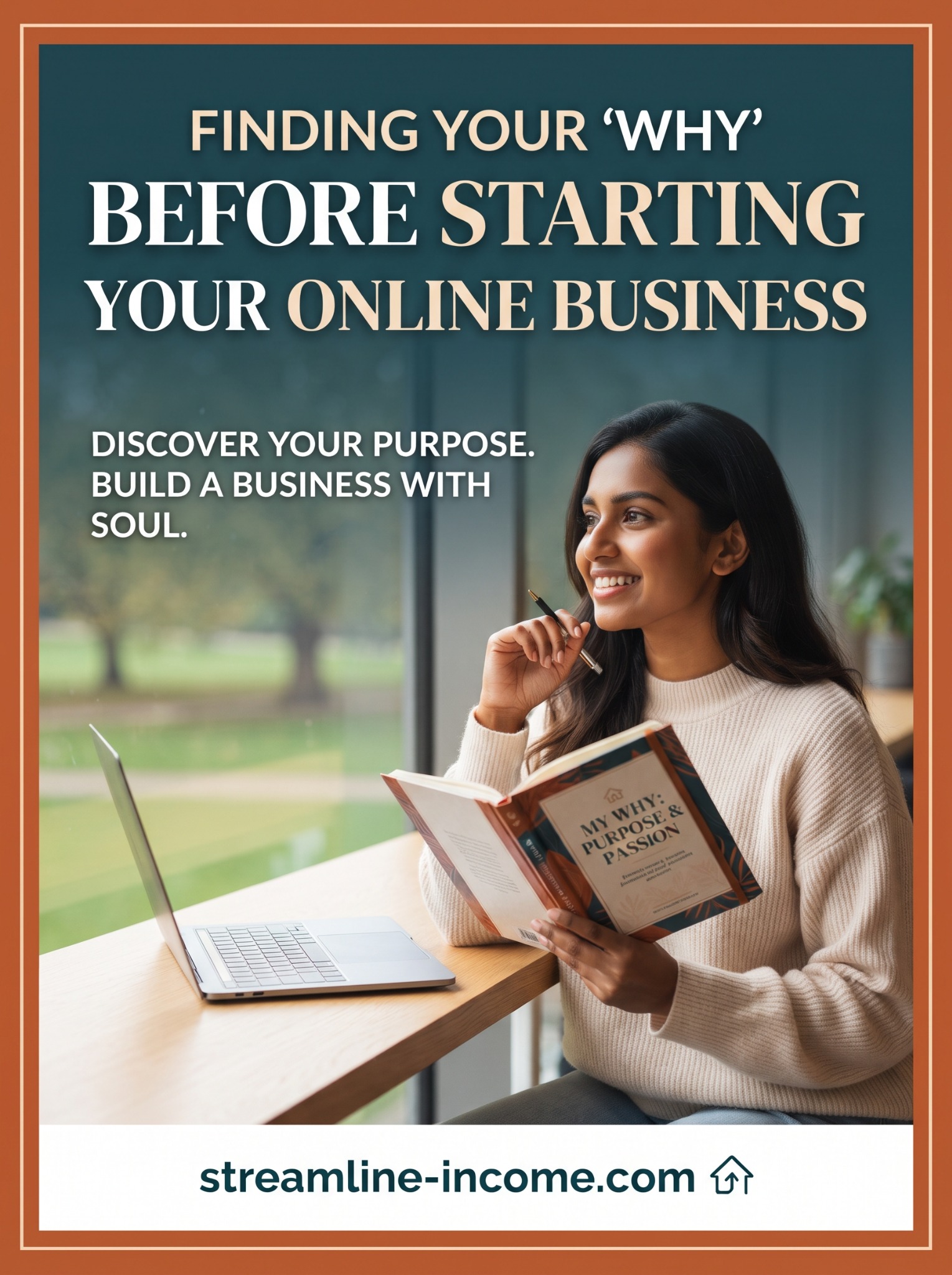
Our Pinterest pin puts it warmly: “Discover your purpose. Build a business with soul.” That purpose can be modest and practical. Perhaps you want more choice over your working hours, an outlet for a skill you enjoy or a small additional source of income.
You do not need a dramatic personal story. You need a reason clear enough to help you decide what to build, what to decline and what kind of effort you are willing to make.
What does finding your “why” actually mean?
Your why is the reason the work matters to you. It sits behind a target such as publishing a website or making a first sale.
“I want to sell digital products” describes a business model. “I want to use my experience to create useful resources in hours I can arrange around my family” explains why that model might appeal.
The distinction matters when you face choices. If flexibility is a priority, an offer requiring appointments every evening deserves careful thought. If you enjoy helping beginners understand a subject, producing clear guides may fit better than chasing a topic you dislike because somebody else earns from it.
Your reason provides a direction to explore. It does not prove that a business idea will work, and it does not have to explain your entire life.
1. Begin with the change you want in everyday life
Think about an ordinary week rather than an idealised future. What would you like more of? What would you like less of? Write the answers in plain language.
- “I would like work I can complete in quiet, uninterrupted sessions.”
- “I want to keep using a skill that my current job rarely calls on.”
- “I would like to explore an additional income source without leaving my employment.”
- “I want a creative project that I can develop at a manageable pace.”
Then ask what each answer means in practice. More flexibility could mean working from different locations, choosing your hours or avoiding fixed appointments. Those preferences may lead to different business choices.
Be honest about what you are moving away from as well as what you want to create. Disliking one part of your current work is useful information, but an online business will still involve administration, maintenance and tasks you do not particularly enjoy.
2. Allow money to be part of your reason
Wanting to earn is a legitimate reason to start a business. You do not have to disguise it as a grand mission. It helps, however, to say what that income would do for you.
Would it contribute to household costs, fund a hobby or give you more options later? A concrete purpose can help you judge whether the time, expense and uncertainty are worthwhile.
Keep aspirations separate from forecasts. “I would like this to contribute towards our household budget” is a goal. It is not evidence that a particular website or product will generate that contribution.
Record the hours and costs involved from the beginning. Sales revenue alone does not tell you what the project leaves after expenses or whether the workload suits you. You can value the learning and creative satisfaction while still being honest about the business results.
3. Name the person you want to help
Your personal reason explains why you want to do the work. A customer's reason for buying is a separate question.
A buyer may appreciate your story, but they still need to understand what the product does for them. Try completing this sentence:
“I want to help [a specific person] do [a useful task] with [a clear resource or service].”
For example: “I want to help first-time allotment holders organise their weekly jobs with a simple seasonal planner.” That gives you a more useful starting point than “I want to inspire everyone.”
Draw on experience you can describe honestly. You might know how to organise information, teach a beginner or explain a practical process. Work within your competence and identify anything that needs specialist input.
If choosing a format is holding you up, explore our beginner digital products guide after you have named the task you want to help with.
4. Check whether the work fits your boundaries
A business can sound appealing while conflicting with the reason you started it. Before committing, write down your limits on working time, spending and availability.
Decide when you can realistically work, how much you are comfortable spending on an experiment and what commitments you need to protect. Include rest. A plan that relies on sacrificing every free hour may be difficult to maintain.
| Your reason | A useful design choice | A trade-off to consider |
|---|---|---|
| More control over your hours | Explore work that can be delivered without live appointments. | Downloads still need customer support and updates. |
| Using a skill you enjoy | Start with a narrow topic you can explain accurately. | You must also learn how to reach people who need it. |
| Keeping the first experiment affordable | Test one small offer before building a large catalogue. | A small test gives limited evidence and may need revising. |
For help turning available hours into a working plan, see our weekly content routine. If the workload is already overwhelming, our guide to side-hustle burnout offers another useful perspective.
5. Turn your values into visible decisions
A business with soul can be expressed through ordinary choices: clear descriptions, fair treatment, useful instructions and promises you can deliver.
Choose two or three values and define what they mean in your work. “Honesty” might mean explaining a product's limitations. “Simplicity” might mean giving customers a clear download process. “Respect” might mean making it easy to find what is included before they pay.
These decisions are more useful than a long list of impressive words on an About page. They also give you something to check when an opportunity arrives.
If you plan to earn through recommendations, our guide to recommending products ethically explores how to keep the reader's needs central.
6. Write a short purpose statement
Bring your answers together in one or two sentences. Treat this as a working note for yourself; it does not need to become a public slogan.
“I am building a small online business to use my practical experience and explore an additional income source. I want to help beginners complete a specific task through clear, affordable resources, while keeping the work within the hours I have available.”
Make yours more specific where you can. Add the audience, the skill or the boundary that matters most to you. Read it before taking on a new project and ask whether the project supports it.
You are allowed to have more than one motivation. Choose the most important ones for your current stage rather than trying to squeeze every ambition into a perfect sentence.
7. Test the idea as well as the motivation
A meaningful purpose is a starting point for research. You still need to understand what potential customers need, what they already use and why they might choose your offer.
The Library of Congress small-business research guide recommends examining industry trends, competitors and the needs a product or service meets. These questions help connect an idea with the market around it.
Begin with a small investigation: review existing resources, note repeated questions from your intended audience and ask relevant people how they currently handle the task. Avoid treating a few encouraging comments as proof that people will pay.
Then make a modest sample or test a clearly described offer. Our seven-day side-hustle test can help structure an initial experiment. Use the results to choose your next step, including changing the offer if the evidence points that way.
A 20-minute reflection you can do today
- Five minutes: write what you want the business to make possible in your everyday life.
- Five minutes: name one person or group you understand and one task you could help them with.
- Five minutes: record your limits on time, spending and availability.
- Five minutes: draft your purpose statement and choose one question to investigate this week.
Stop when you have a useful first version. If you keep rewriting it instead of testing anything, read Why Perfectionism is Delaying Your Online Success. Reflection should lead to a decision you can act on.
Frequently asked questions
Do I need a passion before starting?
You need enough interest in the work and the problem to explore them honestly. A business can grow from a useful skill or a practical goal without starting as a lifelong passion.
Can my why change?
Yes. Your circumstances and understanding of the work may change. Revisit your statement after a small test or a change in your available time. Updating your plan can be a considered decision.
Should I share my personal reason with customers?
Only as much as you want to. A short, relevant story can explain your approach, but you can keep family circumstances and private goals to yourself. Customers still need clear information about the offer.
What if I have a strong why but the idea is not working?
Review the audience, offer, visibility, workload and costs. You may be able to serve the same purpose with a different project. A meaningful reason does not oblige you to continue an unsuitable business indefinitely.
Start with a reason you can use
Your why does not need to sound impressive. It needs to help you choose work that matters to you, serves someone else and fits the life you are trying to build.
Write a few honest sentences, choose one useful question and investigate it. You can develop the business as you learn.
Turn your reason into a first step
Use our free Side Hustle Starter Guide to begin planning without joining a mailing list. If you decide you need paid business training, read our featured system review and compare its current contents and cost with your specific learning needs. Buying is optional, and no course guarantees income.
Ad · Explore the featured online-income offer