MINDSET · CONFIDENCE & SELF-BELIEF
How to Handle Self-Doubt When You Work for Yourself
By Streamline Income · 20 October 2026 · 10 min read

You have spent the morning working on your business. Then a potential customer fails to reply, you notice someone else’s polished website, or you reread a paragraph you wrote yesterday. Suddenly, the question changes from “What should I do next?” to “Am I actually capable of this?”
Working for yourself can leave plenty of room for that question. You make the decisions, judge your own work and often deal with uncertainty without a colleague nearby. A disappointing result can start to feel like a judgement on you personally.
You do not have to eliminate every doubt before doing useful work. A more manageable aim is to notice the doubt, check what it is telling you and choose a proportionate response.
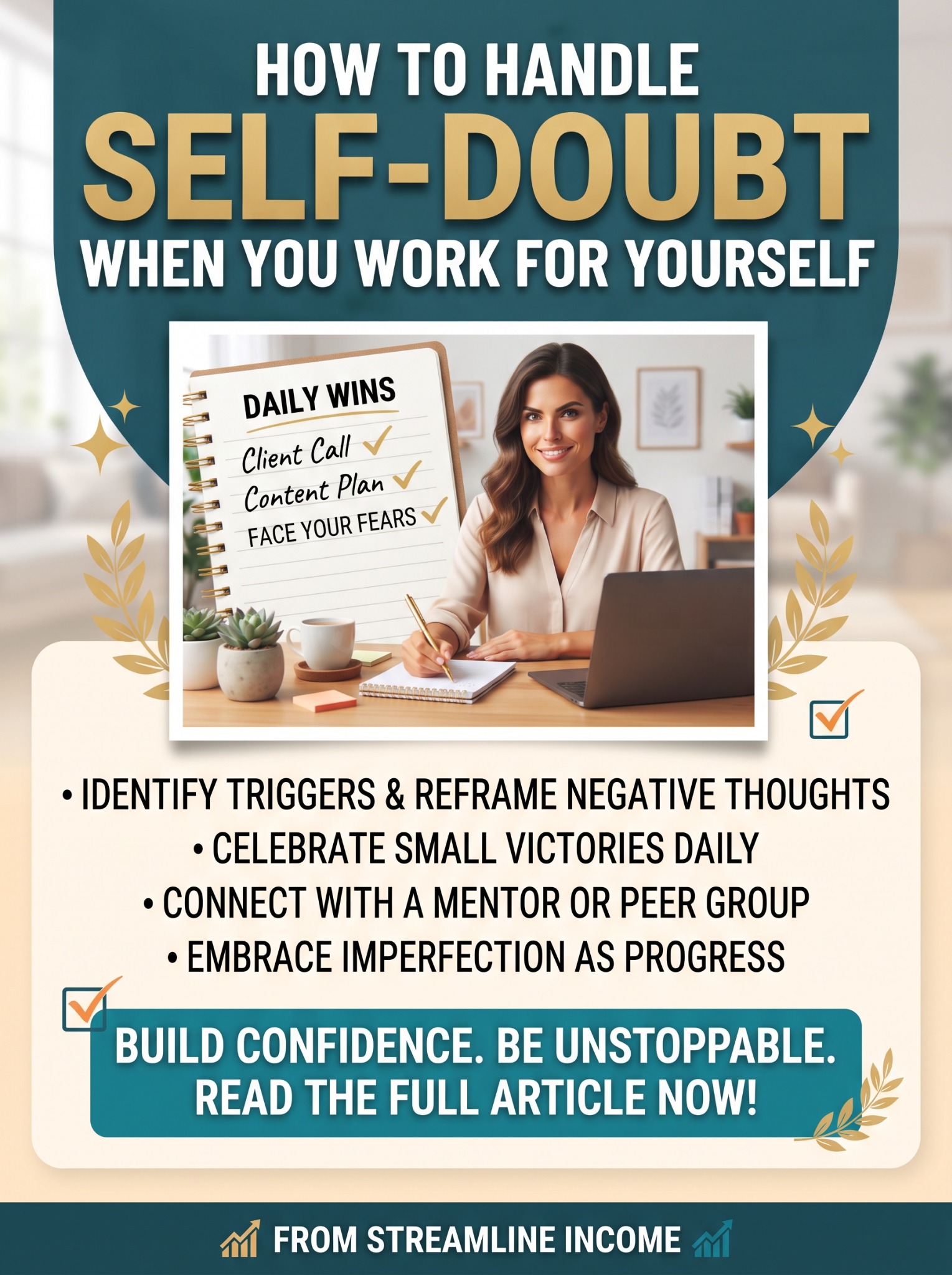
Our Pinterest pin highlights four useful themes: recognising triggers, noticing small victories, connecting with others and allowing room for imperfection. Here is how to turn those themes into practical steps for the everyday business of working alone.
Notice what happened before the doubt appeared
“I doubt myself all the time” is a difficult starting point because it contains no clear situation to examine. Try describing one recent moment instead.
Perhaps you checked your sales figures after a quiet week. Perhaps you opened social media before beginning a task and saw someone announcing a successful launch. Or perhaps a client asked a question you could not immediately answer.
Write down what happened, what you thought and what you did next. Keep it brief: “No reply to my proposal. I thought the offer must be poor. I started rewriting the whole service page.”
This is a way to make the situation clearer, rather than a requirement to analyse every feeling. You may notice that some decisions deserve a calmer review instead of an immediate reaction. Checking results at a planned time can also give your working session a more useful beginning.
Separate the event from the conclusion
A customer has not replied. That is the event. “Nobody will ever want this” is a much wider conclusion.
There may be a problem with the offer. There may also be other explanations: the person is busy, the timing is wrong or the proposal needs a clearer next step. You do not yet know which explanation fits.
The NHS guide to reframing unhelpful thoughts suggests examining the evidence and considering alternative perspectives. A neutral interpretation can be useful; you do not have to turn every concern into a positive statement. The guidance also recognises that changing a thought is not always possible and does not remove the underlying problem.
For your business, a balanced sentence might be: “I have not had a reply yet. I can review the proposal and decide whether a reasonable follow-up is appropriate.” That gives you something to do without pretending you know the outcome.
Ask whether there is a practical gap to address
Not every concern is an unhelpful thought. Sometimes you need more information, practice or a clearer process.
If you are worried that a download will fail, test the download. If you cannot explain what a customer receives, improve the description. If a task falls outside your ability, narrow the offer or learn the missing skill before promising it.
This distinction matters because reassurance alone will not fix an actual delivery problem. Equally, repeatedly rebuilding a tested process may not answer the feeling that you are somehow not good enough.
Our guide to starting an online business when you don’t feel qualified separates confidence gaps, skill gaps and requirements that need checking. Use it when your doubt is centred on whether you can responsibly deliver the work.
Use a fairer response, not an exaggerated one
You do not need to replace “I will fail” with “I am unstoppable.” Both statements claim more than you can know.
Try a response that acknowledges the uncertainty while leaving room for action. “I have prepared a small version, and I can learn from how people use it” is more grounded than promising yourself instant success.
| The thought | A more balanced response | A practical next step |
|---|---|---|
| Nobody wants what I make | I do not yet have enough evidence about demand | Ask relevant people about the problem |
| Everyone else is ahead | I am seeing their public work, not their whole situation | Return to my current task |
| One mistake means I am not capable | This mistake needs correcting; it does not describe all my work | Fix it and check the process |
| I must know every answer | I need to be accurate and honest about my limits | Check the answer or explain the boundary |
| A quiet week means the business is finished | One week is one part of the picture | Review results and assumptions at a planned time |
These are examples to adapt, not phrases you have to believe on command. If a concern points to something important, investigate it. The aim is clearer judgement, not dismissing inconvenient information.
Keep a record of useful work you have completed
The pin’s “daily wins” notebook includes a client call and a content plan. Those are helpful examples because they are observable pieces of work rather than vague instructions to feel confident.
After a client conversation, record what you clarified: the task, the scope or the customer’s next step. After planning content, record the question your article will answer and the outline you completed.
Include corrections and learning too. “Found an unclear instruction and improved it” is a legitimate result. You do not need to describe every task as a breakthrough.
A short record gives you something specific to refer to when your memory of the week is simply “I didn’t do enough.” Our article on finishing one small task each day explains how to create a useful done list without turning it into a productivity contest.
Give the next task a manageable boundary
When doubt appears, you may feel tempted to solve your entire future before returning to work. Try identifying what the current situation actually requires.
If publishing an article feels daunting, complete its factual and link checks first. If a client call feels difficult, prepare the three points you need to clarify. If the offer is uncertain, create a small sample and seek relevant feedback.
The pin encourages readers to face their fears. For ordinary work tasks, a practical interpretation is to prepare a manageable next step within your abilities. It does not mean taking unnecessary risks, ignoring distress or accepting work you cannot deliver.
You can feel uncertain and still take a carefully chosen action. You can also decide that more preparation, a pause or support is the appropriate next step.
Find people who can offer perspective
A mentor or peer group can give you somewhere to discuss a decision that feels difficult to evaluate alone. The useful part is thoughtful perspective, not a guarantee that someone else will approve every idea.
Start with a specific question. “Is this service description clear?” is easier to answer than “Do you think I can succeed?” Share a relevant sample or explain the decision you are trying to make.
Look for people who respect your circumstances and can disagree without belittling you. Be cautious about anyone who uses your uncertainty to pressure you into expensive commitments or promises certain success.
You do not need to pay for a mentor simply to begin. A trusted colleague, an experienced friend or a well-run community may provide a useful first conversation. Keep client information private and agree what you can share.
Allow drafts to be imperfect while keeping standards clear
“Embrace imperfection” should not mean sending careless work to customers. It means recognising that different stages need different standards.
A private outline can be rough. A draft can contain notes about what needs checking. A published guide should be accurate, readable and suitable for its intended use. A customer deliverable should meet the scope you agreed.
Define the finish line for the current stage. If you are drafting, finish the draft before editing every sentence repeatedly. If you are publishing, use a short check rather than relying on whether the work finally feels beyond criticism.
Confidence does not require producing something nobody could ever improve. It requires taking reasonable care, being clear about what you provide and responding responsibly when an issue appears.
Limit comparison that interrupts your work
Other businesses can provide useful examples, but browsing them without a question can become a way to avoid your own next step.
If you are researching, decide what you need to learn. Perhaps you want to understand how similar services explain their scope. Make notes, close the examples and return to your own offer. Do not copy someone else’s work or assume their presentation proves financial success.
You may also choose to keep social media closed during a focused session. This is a working preference you can test, not a rule that everyone needs to follow.
Our guide to building a weekly content routine can help you give research, writing and review separate places in your week.
Do not make purchases carry the weight of confidence
Buying a course, a new laptop or another planning tool can feel like progress. Sometimes it solves a real problem. Sometimes the original uncertainty is still there when the purchase is complete.
Before spending, name the practical gap. Is your equipment preventing you from completing the task, or are you hoping a new setup will make you feel more legitimate?
Our Recommended Products page includes workspace equipment such as a refurbished laptop and office chair. Consider those only when they fit an actual need, and review the current listing details. Our office chair guide offers practical considerations if your workstation needs attention.
No product is a requirement for believing in yourself. Use the tools you already have when they let you do the work adequately.
Make room for support beyond business advice
A difficult business decision and a persistent struggle with wellbeing are not necessarily the same problem. If doubt or distress is regularly disrupting sleep, everyday activities or your ability to cope, consider speaking with a qualified health professional.
You do not have to turn every hard day into a business lesson. Taking time away, talking to someone you trust or adjusting your workload can be sensible choices. This article offers practical work-related reflection, not a diagnosis or treatment plan.
Frequently asked questions
Does self-doubt mean my business idea is wrong?
No single feeling establishes whether an idea is viable. Look at the actual problem, feedback, costs and results. Our guide to believing in your business idea explains how small tests can help you learn without overcommitting.
Should I wait until I feel confident before launching?
Use readiness checks as well as feelings. Can you deliver what you promise, have you checked the work and are the relevant requirements understood? If important gaps remain, address them. Complete certainty may never arrive.
What if someone criticises my work?
Separate specific, useful feedback from broad personal judgements. Check whether there is a problem to correct. You can learn from a criticism without accepting every opinion as accurate or changing everything immediately.
How often should I record small wins?
Choose a light routine that helps you: a sentence after a work session or a short weekly review. You do not need a perfect daily streak, and rest does not require earning enough checkmarks first.
Can I still change direction?
Yes. Continuing, adjusting, pausing and stopping are all decisions you can consider using evidence and your circumstances. Changing a project does not mean you were wrong to explore it or that you lack determination.
Choose one fair question and one useful step
When doubt appears, ask: “What happened, what am I assuming, and what would help me judge this more clearly?” Then choose one proportionate action.
You do not need to become unstoppable. You need room to learn, people you can turn to and a way of working that does not make every uncertain moment a verdict on your ability.
Choose your next practical step
Start with our free Side Hustle Starter Guide. If you are comparing structured learning options, read our featured system review before exploring the offer below. Check its current contents and cost against your needs. Buying is optional, and no course guarantees income.
Ad · Explore the featured online-income offer