MINDSET · MOTIVATION & CONSISTENCY
The Power of Finishing One Small Task Each Day
By Streamline Income · 20 October 2026 · 10 min read

You sit down to work on your online business and immediately see twenty things that need attention. There is a blog post to write, an email to answer, a product description to improve and a website page you have been meaning to check.
An hour later, you have opened several tabs and started three different jobs. Nothing feels finished. You close the laptop wondering why you worked without getting anywhere.
One small, useful task with a clear finish line can give your next work session a better shape. It will not build an entire business on its own, but it can turn a vague intention into something you can complete, review and build on.
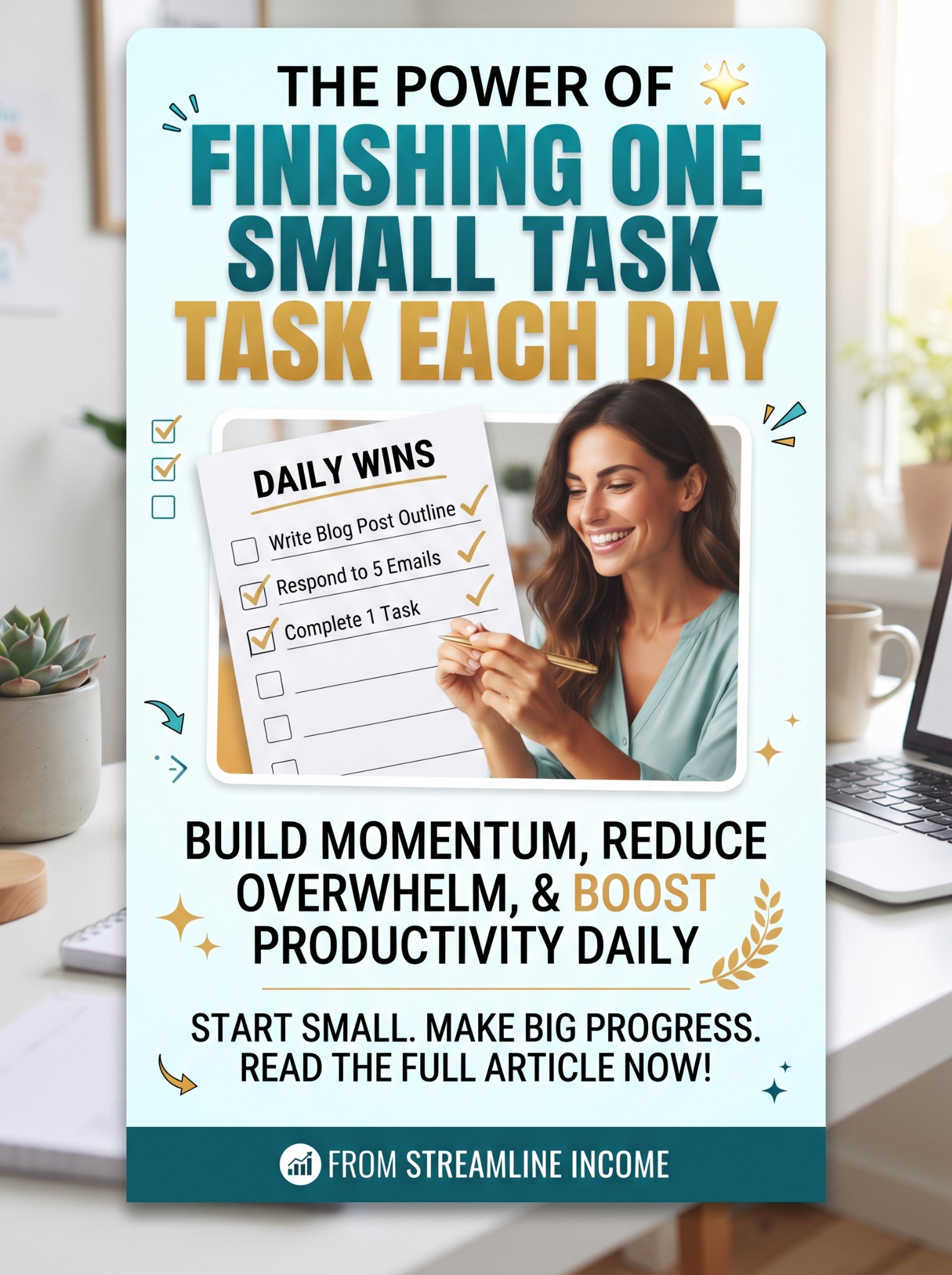
The message on our Pinterest pin is “Start small. Make big progress.” The practical version is simple: choose a task that matters, define what finished means and give it your attention. Then recognise what you completed before rushing towards everything still left to do.
What counts as one small task?
A small task is a defined piece of work you can reasonably finish within the time and energy available. It has an outcome you can recognise.
“Work on my blog” is an area of responsibility. “Write five headings for an article about my readers’ most common question” is a task. “Sort out my emails” is open-ended. “Reply to the five customer messages waiting for an answer” has a visible boundary.
Small does not mean trivial. Correcting a broken download link may take only a few minutes and matter considerably to the person trying to use it. Changing the colour of a button for the fifth time may take longer without solving anything important.
Choose the task because it helps a reader, supports a customer or moves a worthwhile project forward—not simply because it is easy to tick off.
Why finishing deserves attention
Starting can be exciting. Finishing requires deciding what the task includes, doing the necessary work and accepting a sensible stopping point.
For a solo entrepreneur, that stopping point is easy to miss. You are the writer, editor, administrator and person thinking about the next idea. One job can expand into several others before you notice.
A finished task gives you something concrete to inspect. You can see whether the email answers the question or whether the outline supports a useful article. You also know where to begin next time.
This is a practical approach to organising work, not a promise that every completed task will increase sales. Some work maintains the business, some teaches you something, and some produces a resource that may prove useful later.
Turn the pin’s daily wins into real actions
Our Pinterest pin suggests writing a blog post outline, responding to five emails and completing one task. Those examples become more useful when you decide what each one means in your own business.
Daily win: write a blog post outline
Choose one reader question. Write a working title, five useful headings and a short note beneath each heading. Add any facts you need to check later. Stop when you have a workable structure rather than beginning another hour of polishing.
The finished outline should make the next writing session easier. If you keep collecting titles without drafting anything, choose one outline to develop before creating more. Our guide to building a weekly content routine can help you connect these smaller sessions.
Daily win: respond to five emails
Decide which messages matter. Customer questions and promised follow-ups may deserve attention before newsletters or general notifications. Read carefully, answer the actual question and check any links before sending.
Five is an example, not a quota. If one complex message needs the whole session, answering that properly may be the more useful win. The purpose is a resolved piece of communication, not a bigger number on your checklist.
Daily win: complete one task
Replace “complete one task” with a specific result. For example: “Check that the free download opens from the welcome email.” That has a clear finish line and a reason to matter.
If you are developing that email sequence, our guide to your first five welcome emails gives you several separate pieces you can write and test over time.
Choose your task before opening everything
Begin the session by asking: “What finished result would make this time useful?” Let the answer guide what you open, rather than allowing your inbox or social feed to choose for you.
You may need to deal with an urgent customer issue first. Otherwise, look at the project you have already chosen and identify its next useful step. Avoid restarting the decision about your entire business every time you sit down.
Write the task somewhere visible. “Draft the product’s contents list” is enough. You do not need a complicated planning system to make one clear decision.
If choosing a direction is the main obstacle, read How to Believe in Your Business Idea Before Anyone Else Does. Small tasks are more useful when they serve a reasonably clear idea.
Define “done” before you begin
A task that can expand indefinitely is difficult to finish. Agree on the boundary at the start.
For an outline, done might mean five headings and supporting notes. For a product description, it might mean a complete first draft that accurately explains what is included. For a download check, it might mean opening the file through the customer-facing link and confirming that access works.
A finished draft is not the same as a finished published article. Keep those stages distinct. Calling a draft complete allows you to move to editing; it does not remove the need to verify facts, links or usability before publication.
Quality still matters. Reduce the scope of the task rather than quietly dropping the checks that make the work reliable.
Match the task to your actual day
Some days offer a quiet hour. Others offer fifteen minutes between responsibilities. Choose accordingly.
| Time or situation | Possible task | Clear finish line |
|---|---|---|
| A brief gap | Check one important website link | It reaches the intended destination |
| A short writing session | Outline one article | Title, headings and supporting notes are saved |
| Time for customer support | Answer a defined set of messages | Each selected question has a considered reply |
| A longer focused session | Edit one product section | The section is accurate, clear and checked |
| Limited energy | Prepare the next session | Files are ready and the next action is written down |
These are examples, not promises about how quickly a job should take. A task can reveal more work than expected. If that happens, note the obstacle and define the next step instead of pretending it is finished.
For more on fitting business work around other responsibilities, see finding time for a side hustle when you work full-time.
Use one daily task as an anchor, not a ceiling
You may have several responsibilities that cannot wait. One chosen task does not mean ignoring customers, deadlines or essential maintenance.
Think of it as an anchor for your own progress: a useful result you intend to complete alongside the responsibilities of the day. If there is room for more, choose another task deliberately rather than opening everything at once.
Equally, one completed task can be enough for a short side-hustle session. There is no need to manufacture extra work because the first job went well.
The aim is a manageable rhythm, not an uninterrupted streak. For this approach, “each day” can mean each planned working day. Rest days and time away from the business belong in the schedule too.
Build a done list as well as a to-do list
A to-do list shows what remains. A short done list records what actually happened.
At the end of the session, write one factual sentence: “Finished the article outline,” “Answered the delivery question,” or “Corrected the download link.” If useful, add the next action underneath.
This record can help you review your week without relying on the feeling that you were always busy. It also makes unfinished work easier to resume: you can see the last completed stage.
Be honest about the result. Watching a tutorial is learning time; applying it to fix a problem is a different outcome. Both can be worthwhile, but recording them clearly helps you understand where your time is going.
Notice when small tasks become avoidance
There is a trap in this approach: choosing comfortable tasks repeatedly while postponing the work that would answer an important question.
You might organise folders every day while avoiding feedback on your product. You might polish an article title repeatedly because publishing the checked article feels uncomfortable.
Ask: “Does this task help someone, reduce a real problem or move the current project forward?” If the answer is unclear, choose a more relevant step.
If the useful task feels too large, make it smaller without removing its purpose. Instead of “Get customer feedback,” begin with “Write three specific questions to ask someone who has this problem.” Then schedule the conversation rather than endlessly rewriting the questions.
Keep tools proportionate to the job
A notebook or simple document is enough to record your task and finish line. A paid productivity app is optional, and setting one up can become another way to postpone the work.
Keep your project files easy to find and save copies of important drafts. If you need equipment for your working setup, our Recommended Products page includes practical options such as a refurbished laptop and external storage. Choose equipment to solve a real limitation, not to make your routine feel official.
For file protection, our guide to external drives and long-term storage explains why one device alone is not a complete backup plan. Buying equipment does not replace deciding what you will finish today.
Review progress without making every day a test
At the end of the week, look at what your tasks added up to. Did you finish a draft, improve a customer process or discover something useful? Are the next steps clearer?
If the list contains plenty of activity but little movement, change the task selection. If the tasks were consistently too large, reduce their scope. If you had an unusually difficult week, adjust expectations before judging the whole approach.
Missing a planned session does not create a debt of twice as much work tomorrow. Return to one sensible next step. Your worth is not measured by checkmarks, and a business routine should leave room for life outside work.
Frequently asked questions
Is one small task really enough to build a business?
One task is a way to organise a session, not a complete business strategy. Over time, tasks need to connect to useful offers, readers or customers. Review whether the work is moving you towards those goals.
How small should the task be?
Small enough to fit the time and energy available, with a result you can recognise. If it repeatedly spills across several sessions, divide it into meaningful stages rather than rushing it.
What if I have an urgent deadline?
Prioritise the deadline and break the required work into manageable steps. This approach should support real responsibilities, not become a reason to ignore them. Get help or renegotiate scope where appropriate.
Should I work on my business every day?
Not necessarily. Choose a schedule that fits your circumstances and includes rest. Consistency can mean returning to planned sessions rather than working seven days a week.
What should I do after missing several days?
Review what matters now, then choose one manageable task. You do not need to recreate every missed session. A short restart is often more practical than an ambitious catch-up plan you cannot sustain.
Choose today’s finish line
Write down one useful task and what completed will look like. Open only what you need, do the work carefully and record the result.
The most helpful interpretation of “start small” is not to lower the value of your work. It is to give worthwhile work a shape you can finish. Start with one clear step, then use what you learn to choose the next.
Choose your next practical step
Start with our free Side Hustle Starter Guide. If you are comparing structured learning options, read our featured system review before exploring the offer below. Check its current contents and cost against your needs. Buying is optional, and no course guarantees income.
Ad · Explore the featured online-income offer