MINDSET · BUILDING INDEPENDENCE
Breaking Free from the 9-to-5 Employee Mindset
By Streamline Income · 4 November 2026 · 9 min read
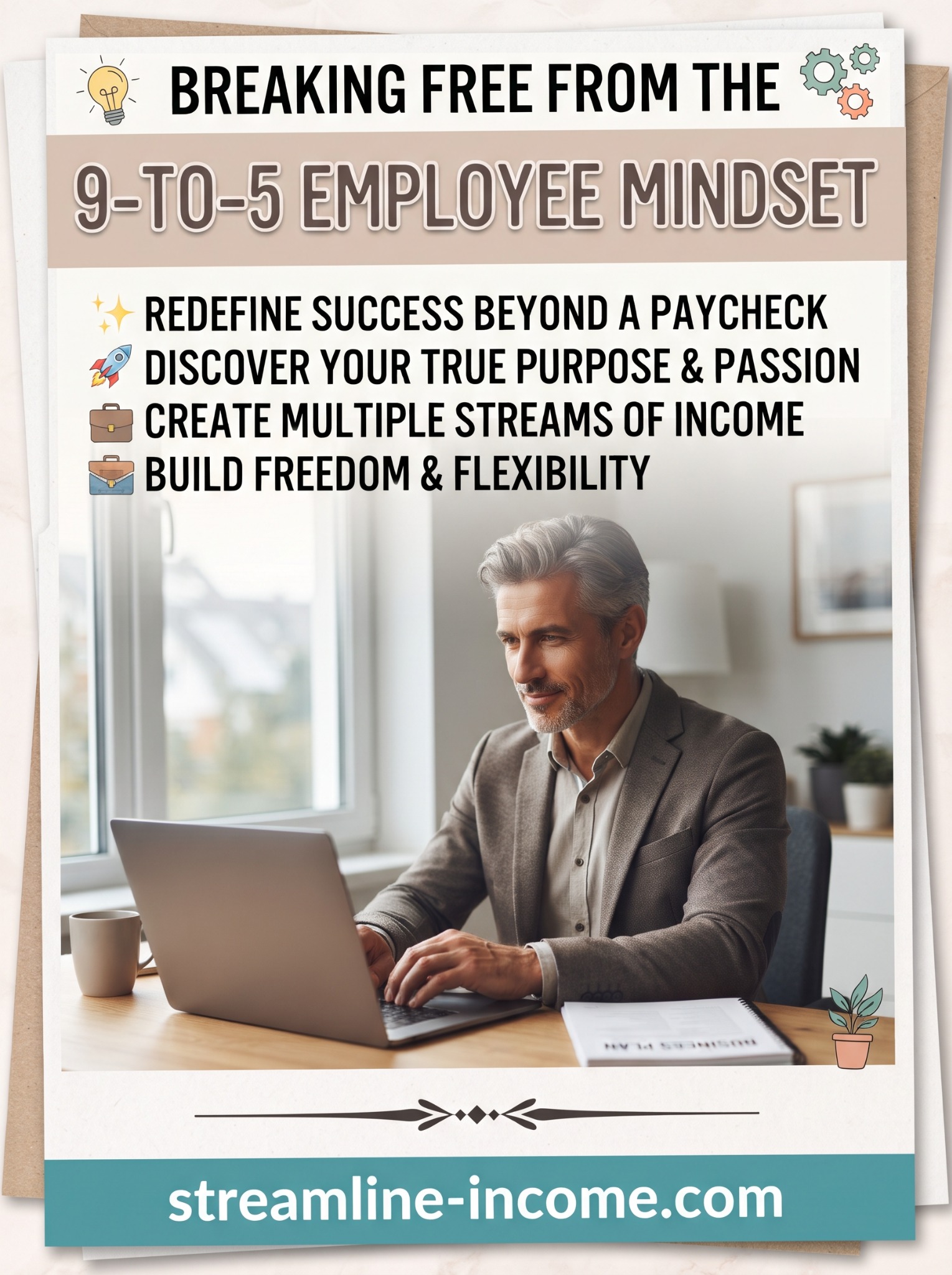
When you have spent years working to a rota, meeting deadlines or following a manager’s priorities, starting something of your own can feel unfamiliar. Suddenly, you are choosing the task, deciding what matters and working out whether anyone needs what you plan to offer.
That change can be exciting. It can also leave you staring at a laptop, wondering where to begin.
Our Pinterest pin highlights purpose, several income sources and greater flexibility. These are useful ideas to explore, provided you turn them into manageable actions. You can begin learning how to run a small business while keeping a job you value.
“Breaking free” starts with making deliberate choices about your own project. It does not require handing in your notice or deciding that employment is somehow a lesser path.
💡 Keep the strengths your working life has given you
There is no single employee mindset. Plenty of employees show initiative, solve difficult problems and take responsibility every day. Those skills can be valuable when you build something independently.
Think about what you already do well. Perhaps you explain complicated information, organise a busy schedule, meet commitments or stay calm when plans change. Write down three skills and an example of each.
Then ask where a person outside your workplace might find that skill useful. Someone who writes clear instructions could explore beginner guides. Someone who enjoys organising information could test a simple planning template.
Use your own experience and original work. Keep employer information, customer details and workplace materials separate from your personal project.
Choose what success would mean for you
The pin invites you to define success beyond a pay cheque. Your earnings still matter, but you can also consider the kind of work and life you want.
Would you enjoy learning a new skill? Would a small creative business give you something satisfying to develop? Would you like to explore work that can be completed without fixed appointments?
Try writing a simple statement:
“I want to build a useful resource for beginners, test whether people need it and see whether the work fits into two evenings a week.”
That is a clearer starting point than “I want financial freedom”. It gives you something to do and something to review. For help shaping your reasons, read Finding Your ‘Why’ Before Starting an Online Business.
1. Move from waiting for a task to choosing a useful next step
In your own project, there may be nobody handing you a task list. You need a small way to decide what deserves attention.
At the start of each session, write down the answer to this question: “What can I finish today that will help me understand or serve a potential customer?”
That could mean checking whether a worksheet is easy to use, drafting a clear description or finding out how people currently solve a problem. It does not have to be a big decision.
Suppose you want to create a meal-planning template. Your next step could be making one sample week and asking someone in your intended audience to try it. Choosing a brand colour for the fourth time is less likely to answer whether the template helps.
Our guide to finishing one small task each day can help you turn a broad idea into a session with a clear endpoint.
2. Measure useful progress as well as hours
Time spent matters because your time is limited. Yet a long evening at the computer does not automatically mean your business has moved forward.
Keep a short record of what you completed and what you learned. A finished sample, a corrected problem or a useful customer question can tell you more than a total of hours alone.
| Activity | Clearer goal | What to check |
|---|---|---|
| Spend an evening researching. | Compare three existing solutions to one customer problem. | What is already available, and what still seems difficult? |
| Work on a digital product. | Complete one usable sample. | Can a target reader use it without extra explanation? |
| Post about the business. | Share a useful example with a relevant audience. | Did it lead to meaningful questions or interest? |
A quiet response is information to investigate, rather than a verdict on your ability. If very few relevant people saw the example, you may need to improve how you reach them before changing the whole product.
3. Let customer needs shape the idea
Enjoying a topic is a helpful starting point. A business also needs people who value what you offer.
Business.gov.uk recommends testing and validating a business idea. In plain language, this means checking your assumptions before committing too much time or money.
Ask how people handle the task now, where they get stuck and what they have already tried. Look at existing offers and read their descriptions carefully. You are trying to understand a problem, not collect compliments.
For example, someone may say a printable planner looks lovely but rarely use printed pages. That answer could help you explore a different format. It is useful feedback even though it is not the answer you hoped for.
A few positive comments do not prove that an idea will sell. Use them to guide a small test, then review what actually happens.
4. Start with one income route you can manage
The pin mentions creating multiple streams of income. That can be a longer-term aim, but each new route brings work of its own.
A service may involve bookings and revisions. A digital product needs creation, delivery and support. Affiliate content needs useful research, clear disclosures and ongoing updates. None becomes effortless simply because it is online.
Choose one small offer or project first. Learn what it takes to make, explain and maintain it. Consider another route when you have a clear reason and room to handle it.
Several products on the same website may still depend on the same traffic source. If that traffic falls, they can all be affected. Count the underlying dependencies as well as the number of products.
Our beginner digital products guide can help you explore a manageable format. There is no need to launch a shop, newsletter and course in the same week.
5. Practise making small decisions with clear limits
You will rarely know everything before trying an idea. Give yourself a small experiment with an endpoint.
Write down what you want to learn, how much time you will spend and when you will review it. If spending is involved, set a limit you are comfortable with before browsing tools or offers.
For instance: “I will spend two sessions making a sample checklist and ask three relevant people to try its main task.” This is an illustrative test, not a rule or a reliable estimate of demand.
Afterwards, decide whether to improve it, investigate another question or stop. Ending an unsuitable experiment can be a sensible use of what you learned.
If fear of getting it wrong keeps you polishing the same draft, see Why Perfectionism is Delaying Your Online Success.
🎄 Use Christmas and New Year as planning points
November is a good moment to look at the weeks ahead. Christmas can bring different shifts, family plans and less spare time. A realistic plan makes room for those changes.
Choose one useful milestone before the holidays: finish a sample, improve a product description or learn how a delivery process works. Avoid turning a festive deadline into pressure to launch something unfinished.
If you decide to test a seasonal resource, make it relevant to a real need. A gift-budget worksheet, for example, should have clear instructions and accurate calculations. A Christmas label on an unrelated product adds little value.
Keep seasonal results in context. Interest in a festive planner may not continue in January, and a quiet holiday week may not reflect normal demand.
For New Year, schedule a short review rather than making a dramatic promise:
- What did I finish or learn?
- Which tasks suited my available time?
- What did potential customers actually do or say?
- What will I continue, change or stop?
You can build a more flexible working life gradually. Our guide to visualizing your ideal work-from-home life offers practical ways to plan your routine and boundaries.
A small plan for your next seven days
- Choose one problem: describe a person you understand and a task they find difficult.
- Use one existing strength: decide how your experience could help.
- Book two realistic sessions: protect rest and existing commitments.
- Make or investigate one thing: a sample, a comparison or a focused customer question.
- Review the result: choose the next step using what you learned.
If you want more structure, follow our seven-day side-hustle test. The goal is a useful first experiment, not a complete business in a week.
Frequently asked questions
Do I have to leave my job to think like a business owner?
No. You can practise choosing priorities, researching customer needs and keeping track of a small project alongside employment. Leaving a job is a separate decision that deserves careful consideration of your circumstances.
What if I do not have a great passion?
Start with a useful skill or a problem you understand. Interest can develop as you learn. You do not need to discover a single lifelong calling before testing a modest idea.
Should I create several income streams straight away?
Begin with what you can deliver and maintain. Adding more routes too early can divide your attention and increase unfinished work. Review the first project before expanding.
How do I know whether I am making progress?
Look at completed work, customer feedback, costs, time and results together. Early progress may be a clearer offer or a useful correction. Earnings matter, but they are not guaranteed by effort alone.
Give yourself one decision to own
Your working experience is something you can build on. Choose one useful problem, decide on a manageable next step and give yourself time to learn from it.
You can appreciate the security or satisfaction of your current work while exploring new possibilities. Start with a small project you can take responsibility for, and let the evidence guide what comes next.
Plan your next small project
Start with our free Side Hustle Starter Guide, available without joining a mailing list. If paid business training meets a specific learning need, read our featured system review before comparing the current contents and cost. Buying is optional and no course guarantees income.
Ad · Explore the featured online-income offer