DIGITAL PRODUCTS · 8 MIN READ · 28 OCTOBER 2026
How to Transition From a Free Newsletter to Premium Digital Offerings
You have been sharing useful advice for free, and readers are starting to recognise your name. Now you would like to offer something paid. The awkward question is how to introduce it without making the newsletter feel like a sales pitch or suggesting that previous generosity came with hidden conditions.
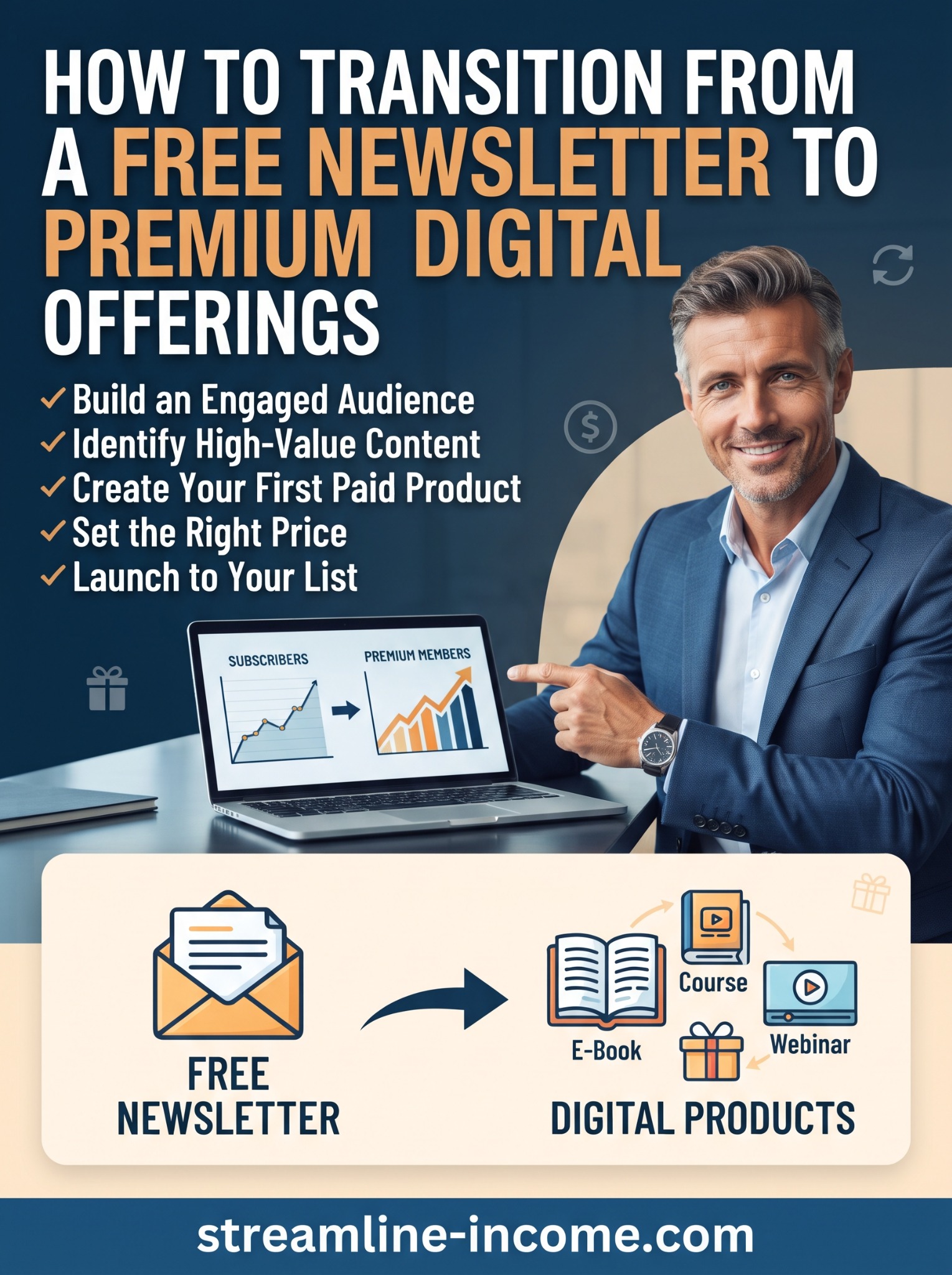
The answer is to make the paid offer a clear, optional next step. Keep helping people through the newsletter, and create a product that gives interested readers additional structure, convenience or support. Our Pinterest pin sets out five stages: build engagement, identify valuable content, create a product, choose a price and launch to your list.
Decide what “premium” will mean
A premium offering does not have to be a paid newsletter. You could keep every newsletter edition free and sell a standalone workbook, template pack, short course or workshop alongside it.
These models create different commitments. A one-time download needs accurate instructions, reliable delivery and a defined support policy. A membership needs an ongoing reason to stay subscribed. A live workshop requires scheduling, preparation and clear expectations about recordings or follow-up.
For a first experiment, consider the smallest format that solves the reader's problem. Our guide to digital products beginners can create will help you compare options. “Premium” should describe a useful improvement, not simply a larger file or a more expensive label.
🔎 Look for a problem readers want to act on
Start with questions people ask repeatedly. Which explanations generate thoughtful replies? Which resources attract relevant clicks? Where do readers say they understand the principle but struggle to put it into practice?
A newsletter about planning content might attract questions about choosing weekly priorities. That could support a practical planning workbook. It does not automatically justify building a twelve-module marketing course.
Ask a concrete question: “What is hardest about planning your next week's content?” Follow up with a short description of the proposed resource and ask what would make it useful. Avoid treating polite enthusiasm as a promise to buy.
Open rates alone are weak evidence of demand. Mailchimp explains how Apple Mail Privacy Protection affects open reporting. Combine reader replies, relevant activity and eventual purchases rather than assuming your most-opened topic is your best product idea.
Make the difference between free and paid easy to explain
The free newsletter should still deliver a complete useful idea. The paid product can help readers apply that idea across a larger task. Do not deliberately remove essential steps from the free explanation to force an upgrade.
| Free newsletter value | Optional paid extension |
|---|---|
| A method for choosing weekly priorities | Editable planners, completed examples and a review workbook |
| A checklist for clearer product descriptions | A writing workbook with templates and annotated examples |
| An explanation of digital-product delivery | A detailed setup guide and reusable testing sheets |
| A short lesson about pricing | A tested calculation workbook with instructions and scenarios |
These are illustrative product pairings, not validated market opportunities. Their strength is that the extra value is visible: organisation, practice, examples or reduced setup effort. Our guide to packaging existing knowledge explains how to create that structure.
Build one complete first product
Write a one-sentence outcome before making the files: “This pack helps a beginner plan four realistic weeks of content around their available time.” Then list only the components needed to support that outcome.
A manageable first pack might include a short guide, an editable weekly planner, two worked examples and a review checklist. Give each file a clear name and include a Start Here page. Do not inflate the package with unrelated bonuses simply to increase the item count.
Ask a small number of suitable readers to try it and describe where they get stuck. Their feedback helps you improve usability, but favourable comments do not prove broad demand. If you offer a discounted pilot, explain exactly what is finished and what participants will receive.
Avoid promising lifetime updates or unlimited personal help without considering the workload. Our micro-products versus masterclasses article explores why a focused scope can make a first launch easier to manage.
💷 Set a price you can explain and test
Consider the problem solved, the quality of the finished resource, comparable alternatives and the work needed to support customers. Your production hours matter, but buyers are evaluating usefulness rather than reimbursing every hour you spent learning.
Suppose a fictional workbook sells for £19 and ten people buy it. That is £190 gross revenue, before platform and payment fees, refunds, taxes and your time. It is an arithmetic example, not a sales forecast.
Check current fees before setting your price. For instance, Payhip's pricing page distinguishes its plan and transaction charges from payment-processor fees. Your actual costs depend on the platform and payment arrangements you choose.
Start with a clear price and an honest description. If you offer a launch discount, use a real end date and avoid an invented “usual price”. Our first digital-product pricing guide gives you a fuller framework.
Prepare the buying experience before announcing it
Create a product page explaining who it is for, the exact contents, file formats, required software and any limitations. Show representative previews. Make clear whether the payment is one-time or recurring, what support is included and how buyers obtain help.
Then test the delivery journey. Check the confirmation message, download links, filenames and the files themselves. Read your sales page again while looking at the delivered package: do they match?
Payhip's digital-product documentation describes file uploads and immediate download access after purchase. Whichever service you use, test its current workflow rather than assuming that uploading a file completes the job. Our delivery guide covers the practical checks.
Introduce the offer without surprising your readers
Explain the addition plainly: “The weekly newsletter will remain free. I have also created an optional planning pack for readers who want editable worksheets and completed examples.” That makes the relationship between free and paid clear.
If you intend to reduce or replace the free newsletter instead, say so before the change. Explain what remains available and what the paid version includes. Do not describe a service as unchanged when most of its value is moving behind a paywall.
Subscribers should actively choose a purchase or subscription; joining a free list is not agreement to pay. Introduce only relevant offers within the permissions and expectations of your audience.
Use a short launch sequence with a purpose for each email
- Teach the problem. Share a useful lesson and briefly mention the resource you are preparing.
- Show the finished offer. Explain the outcome, contents, price and who should consider it, with one clear product-page link.
- Answer genuine questions. Clarify suitability, formats or support, and include a reminder only where useful.
This is an example sequence, not a requirement to send three emails in three days. Fit it around the frequency readers expect. If you promise a launch deadline, honour it; without one, there is no need for a “last chance” message.
Where your system allows, stop sending purchase reminders to people who already bought. Give them useful onboarding instead. Our subject-line guide helps keep those messages clear and accurate.
If you are comparing broader business resources, you can review our featured ClickBank offer (affiliate link). It is optional; you do not need to buy it to test a focused product of your own.
Review the launch before adding another commitment
Record product-page visits, attributable purchases, refunds, support questions and customer feedback. Look for where readers hesitate: unclear contents, an unsuitable format or a price they cannot connect to the value.
A low sales count does not automatically mean you need a discount. Small audiences provide limited evidence, and one launch cannot isolate every cause. Improve one clear issue and review again.
The pin also shows premium members, but recurring revenue brings recurring delivery work. Before launching a membership, define the schedule, ongoing benefit and support limits. Payhip's membership guide distinguishes a posting-based membership from access to product bundles. Choose the model that matches what you can reliably deliver.
Conclusion: offer a useful next step, not an obligation
The strongest transition builds on an existing reader need. Keep your free promise clear, create one worthwhile paid resource and make the buying decision straightforward. A well-supported first product gives you better information for the next step than an ambitious catalogue built on guesses.
Frequently asked questions
How many subscribers do I need before selling?
There is no fixed threshold. A small relevant audience can test an offer, but avoid treating a handful of responses as a dependable revenue forecast.
Will readers resent a paid product?
Some will not want it, which is fine. Clear expectations, useful free content and optional purchases help readers decide without pressure.
Should I start with a course or an ebook?
Choose the format the task needs. Demonstrations may benefit from video; planning and reference tasks may suit written guides and templates.
Is Streamline Income introducing a paid newsletter?
No. This article explains an option for readers. Our free starter guide remains available without an email sign-up.
Explore the featured business resource
Review the offer's contents, current price and terms before deciding whether it fits your needs.
View offer and purchase optionsAffiliate link: we may earn a commission if you purchase. Results are not guaranteed.
Share this article
Know someone who would find this useful?